

Learning a second language can be fundamentally transformative. Beyond the cognitive advantages of flexibility and problem-solving, or the enriched comprehension of different cultures, learning a second language yields a palpable confidence and a more-informed experience, according to faculty in the College of Arts and Sciences (CAS)& Department of Romance Languages. These reasons could be why enrollment in romance languages has been trending upwardsin CAS, an increase of 20% overall since 2025.
Romance languages are derived from the everyday spoken language of the Roman Empire,and they include French, Italian and Spanish. As they share a significant amount of vocabulary and similar grammatical structures, people who speak a romance language become part of a network of some 1.2 billion speakers worldwide.
In the last decade, majors in the Humanities such as Romance languages have been a challenged academic discipline. According to the most recent study from the Modern Language Association, national enrollment in languages other than English dropped by 16.6% between 2016 and 2021. This decline is compounded by 2025 federal funding reductions in romance languages, mapped by the Center for American Progress.
However, over the past two years, CAS’s Romance Languages department completed a lengthy overhaul of its curriculum to promote student success, with a focus on one-on-one advising with students.
For example, French, Italian and Spanish 203 courses now count toward Romance language majors and minors, which encourages students to declare majors or minors since they already earn four credits toward their degree. The department has also developed affordable, instructor-authored materials. Language study abroad programs let students earn credit for courses across a variety of disciplines, ensuring they are supported in exploring new interests. Similarly, the Schnitzer School of Global Languages and Studies promotes interdisciplinary collaboration.
Growth in Italian language enrollment
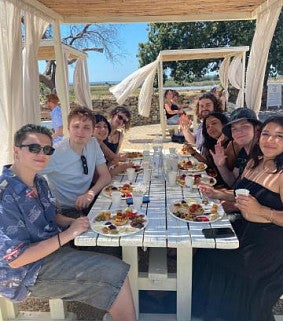
Nathalie Hester, associate professor of Italian, called the curriculum and program changes strategic. “We are constantly reviewing and updating our first-& and second-year curricula,” she said. Not many students come to the university having studied Italian, as opposed to Spanish or French. While first-year retention is a challenge across all languages, Hester said the Italian program sees a near 100% retention in the second year.
Maya Hall ’26 has been taking Italian classes for three years. “I think romance language enrollment has increased because of positive reviews students are sharing with other students about the program,” she said.
The small class sizes, engaging professors, fun exercises and opportunities to talk with people in Italy enriched her education, Hall said. “It opened my eyes to another world.”
Italian minor Audrey Bunce ’24 (global studies) moved to Italy for an internship as a high school English assistant. “I never would have pursued that internship if I hadn't been introduced to it by Professor Nathalie Hester, she said.
Bunce remained in Milan with a long-term position as an English teacher. “I definitely wouldn't say that I'm fluent, but every time I speak Italian, I'm using things that I learned in class.”
Spanish and the Spanish Language Heritage Program
In the Spanish program, Cecilia Enjuto Rangel, associate professor of Spanish and director of undergraduate studies in Romance languages and Spanish, attributes enrollment growth to the changes in major and minor requirements that make it more feasible for students to graduate in a timely manner. She also credits enrollment growth to active advising and the& natural progression of students beginning as minors, who are encouraged to major in the language.
“Our students continue taking our classes because they like them, they like the small classroom setting, and they connect with the professors,” she said.
She often helps students declare as majors when she goes over their degree audit, and if they have taken classes in a study abroad program, she helps them make the classes they have taken in the target language count towards their degree. Enjuto Rangel also mentioned how the visibility and support of the Schnitzer School has been a way of strengthening Romance languages’ connections with other majors.
Brandon Rigby PhD ’17 (romance languages, literatures, linguistics), who was Enjuto Rangel’s doctoral advisee, is an example of someone who never intended to major in Spanish until a professor suggested it. He is now a foreign service officer for the U.S. Department of State.
A distinct program in Romance languages is the Spanish Heritage Language Program (SHL), which is designed specifically for students who have a personal, familial or community connection to Spanish. Sergio Loza, assistant professor of Spanish linguistics and SHL director, said it was created due to an influx of Latino students attending the UO who had experience speaking Spanish at home and could benefit from cultivating it through their studies.
In winter 2020, enrollment was at 152. As of winter 2026, there are 200 students in the program, a 32% increase.
“I'm just surprised that each fall, we just get more and more inquiries from incoming freshmen,” said Loza.
Loza continued to explain that pre-law, pre-med and psychology majors are going out of their way to obtain a Spanish major or minor. “They know it's beneficial for them professionally and on a personal level as Latino students who are reclaiming their Spanish.”
French language enrollment

Ciaran Moses ’26, a double major in French and political science, enjoys the freshness of learning beyond the language itself. “Learning culture and history through another language is really fascinating, and I think it's a different experience from learning it in English.”
The overall enrollment increase has brought more students to his French classes. “There are more people, so there are more perspectives to hear from,” he said. “I’ve met so many great people and participating in so many full classes is wonderful.”
The concrete advantages of language comprehension are extremely valuable in their own right, but Fabienne Moore, associate professor of French, believes it goes further: “Growing as an individual by making yourself vulnerable and exposing yourself to other cultures, other habits, other turns of phrase, other concepts that are untranslatable, that really changes the person. I think we are all convinced that in the Department of Romance Languages — that you actually transform yourself when you learn a language. That is a beautiful process.”
Moore’s perspective comes from her own experience as a non-native English speaker. “I learned English, and it's like, wow, the world that it opened for me is what I'm hoping happens with every single student I teach in French, opening the world, both within and then towards others.”
Moore said there is an impulse to create connections between the other languages, the global studies major, and the whole school, and that impulse of promoting dialogue and communication is also felt among the students.
“The atmosphere in Romance Languages is utter joy that students seek out classes with us, and that we are able to increase our student demand and student interest in our programs.”
— By Violet Ashley, College of Arts and Sciences