
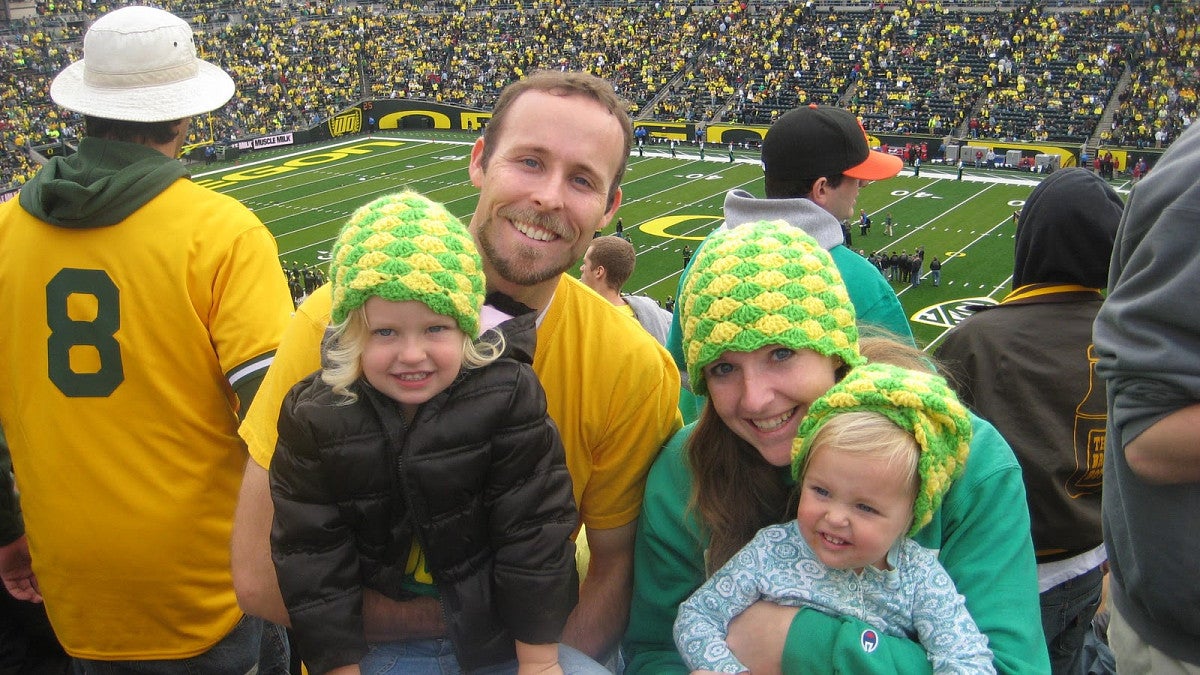
Brandon Rigby, PhD ’17 (romance languages, literatures, linguistics) never imagined he would speak Spanish as a career, let alone use it to represent the US around the world as a foreign service officer for the U.S. Department of State. Seven years and three countries later, he would not change a thing.
While getting his undergraduate degree at Weber State University in Utah, an advisor suggested he pursue Spanish. Although he had taken a Spanish class every term, he never considered it a viable profession for himself.
But that advisor’s suggestion planted an idea that grew into two master’s degrees and a doctorate from the University of Oregon College of Arts and Sciences. He chose the UO on a whim, driven by his love for the region, with the intention of becoming a professor. It quickly became home.
Developing his specialty at the UO
For Rigby, the switch to solely studying Spanish was intimidating: “I never saw myself being as good at teaching or at speaking Spanish as my professors were. But that was a good thing about UO because, like anything in life, you just learn a little bit at a time.”
Rigby had studied Spanish in middle and high school and had even lived in Spain for two years at age 19 as a missionary for The Church of Jesus Christ of Latter-day Saints. “I fell in love with the language, the Spanish culture and the people —just everything about it. It’s been with me my whole life now.”
At the UO, Rigby also worked with the Global Education Oregon (GEO) study abroad office and taught as a graduate fellow.
Taking his Spanish skills global
While applying for academic positions, Rigby received a State Department recruitment email from his romance languages professor. Since jobs in academia were limited, he took a diplomatic exam as a backup. He thought little of it until he was repeatedly invited to continue in the selection process. Upon graduation, he received a job offer.
The position was a chance to use his Spanish skills and to travel consistently. He and his family agreed to give it a shot for a couple of years, reasoning that if it was not a good fit, they could find something else. They have lived in three different countries since.
As a foreign service officer, Rigby relocates every two to three years. For the consulates in Ciudad Juárez, Mexico, and Quito, Ecuador, he interviewed people coming in and out of the US seeking study, travel and immigration visas. Sometimes his office would have to interview as many as 750 people in just four hours, giving him only a one- to two-minute conversation to determine whether the candidates would qualify for a visa.
“It's taxing emotionally, especially in Mexico, when I was working with the people applying to become residents or citizens in the US. That's a decision that could impact their entire lives.”
However, he said, it was also the most rewarding component of the work: “The times that a correct decision means that I could invite someone to come to the US and feel like they would have a positive impact on their community, that was my favorite part.”
Using a liberal arts degree for the 21st century
State department jobs do not specifically require a doctorate-level degree. For example, Rigby’s colleagues learned Spanish from the government’s Language Institute specifically for their positions. However, after so many years studying Spanish language and culture, Rigby has a more well-rounded understanding of both. The UO, he said, emphasized the importance of different nuances of the language’s socio-historical context.
While in Ciudad Juarez and Quito, Rigby's job was a limited non-career appointment. He is now a foreign services officer – a specific career path in the State Department. He and his family chose Warsaw, Poland, out of the options they had because it fit the family's needs the best. In the new post, Rigby enjoys working behind the scenes supporting diplomats.
“Some days it feels like it's too challenging, but kind of like the PhD, I'm learning stuff every day. I could never see myself in a job where I feel like I know it all two weeks in.”
It is a big change to live in a country where very few people speak Spanish. Rigby has been learning Polish for two years, putting him back into the role of language learner. “I still get that butterfly in my stomach every time I have to interact. But I've also learned how to manage that somewhat, and I think so much of that came from my time at UO.”
Rigby leans into the vulnerability of learning. “With my PhD in Spanish, my degree is really a humanities degree,” he said, which teaches how to become comfortable with uncertainty. His advice for students is to explore new interests, as he would not have known this to be his ideal career without continually reevaluating his plans.
A family with a global perspective
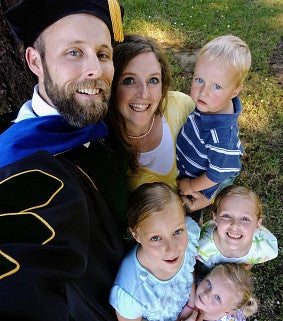
Rigby’s first daughter was only five months old when he began his first master’s program in 2008. By the time he received his doctorate in romance languages, literatures and linguistics in 2017, his children were ages 9, 7, 4 and 2. They lived in Spencer View student family housing, which Rigby describes as a “microcosm” of the university: “You get people from all different programs, from all different countries, and out kids would just go outside and play with other kids.”
Making personal connections is Rigby’s favorite part of moving around often. “We’ve been lucky to have had really good communities at the embassy or consulate itself, but also with our kids in international schools, we've become friends with families from all over the place. So very, very similar to our time at UO.”
Next summer, they will move to the embassy in Fiji. “I don't know very much about Fiji, but I'm very excited to learn,” Rigby smiled.
—By Violet Ashley, College of Arts and Sciences