
By Violet Ashley, student writer, College of Arts and Sciences
What America will we choose to build during the next 250 years? This was the driving question behind the The Harold Schnitzer Distinguished Symposium on Oct. 6, “We Hold These Truths: 250 Years of the American Experiment at Home and Abroad.” It was the first in a new annual public symposium series hosted by the Schnitzer School of Global Studies and Languages to discuss the most important issues facing the world.
Connecting the global and the national, a panel of experts discussed the contested legacy of the American experiment on the 250th anniversary of the country’s founding. “The national and the global are not opposites,” said Aneesh Aneesh, executive director of the Schnitzer School. “From the beginning, the American project spoke in strikingly universal terms. The Declaration did not simply define rights for Americans; it made a claim about humanity.”
A generous endowment from Jordan Schnitzer and the Harold & Arlene Schnitzer CARE Foundation to the Schnitzer School supported the launch of the symposium series.
“There's not the discourse nationally that there should be about these changes,” said Schnitzer. “We somehow are lacking the will to come together more often and talk about these issues and talk about constitutional rights, so I'm thrilled we were able to help create this program.”
University of Oregon President Karl Scholz remarked that a standing public forum is a fitting way to carry Schnitzer’s father's name and his family’s legacy forward.
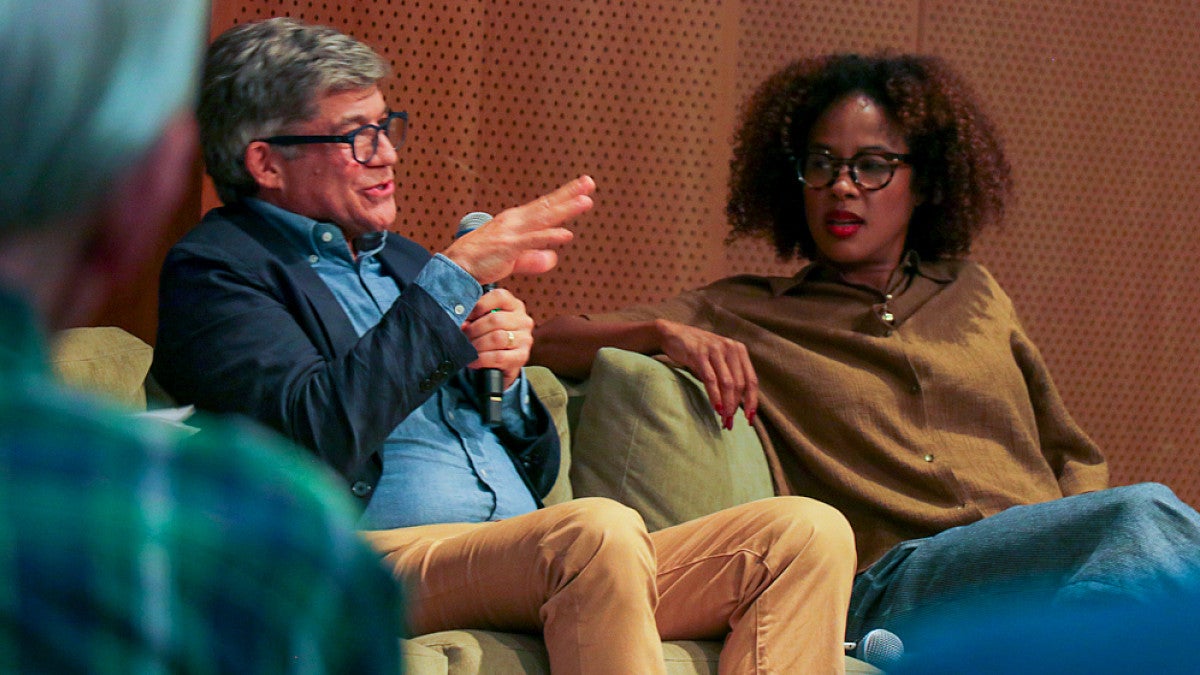
The panel consisted of Pulitzer Prize–winning journalist Nicholas Kristof and leading scholars of citizenship, political development, race, gender, immigration and civil rights Peter J. Spiro , Carol J. Nackenoff and Megan Ming Francis. Dan Tichenor, director of the Wayne Morse Center for Law and Politics, moderated the panel.
Understanding the Declaration
One major point of conversation was the Declaration of Independence. Nackenoff, Richter professor emerita of political science at Swarthmore College, described how the Declaration is aspirational to many Americans. While the framers had a narrow vision of the men who would benefit from it, its claim of universality has built a country continually attempting to widen that original in-group.
“We don't even agree on what the Declaration of Independence says or its relationship to the Constitution,” she said.
Kristof, opinion columnist for The New York Times, attributed this to how America was born of myths that, although they may not be fully achieved and include some self-deception, are powerful.
“There is actually something to be said for some of the founding myths and myths that have sustained us — the land of the free and the home of the brave and the American dream — and that those myths actually have real power to drive action, to change action,” he said.
The issue now is that there is some retreat from those aspirations.
Francis, G. Alan and Barbara Delsman associate professor of political science and associate professor of law, societies and justice at the University of Washington, asked, “Whose declaration is this, and how should we understand it today, and what does a celebration of that mean?”
She described how leaders have used language from the Declaration to implore both political elites and ordinary people to try to live up to these myths.
Institutions, ideals and theories do a lot, said Francis, but it is people who “reimagine what independence might look like.”
Distrustful belonging
Immigration dominates the American political conversation now, yet Spiro, Charles Weiner chair in international law at Temple University, recalled that for the first century of American history, there were no federal immigration controls, noting that the Constitution does not explicitly address immigration.
Spiro thinks that while social views on and experiences with immigration remain more or less the same today as in past decades, the concept of citizenship has changed radically.
“Citizenship has historically been considered an unalloyed good,” he said. “It's reflected equality, it's reflected rights and it's reflected community. And I think all of those are starting to break down to the point where we can start talking about citizenship as really a marker of privilege rather than a badge of equality.”
Kristoff noted how much of a touchstone it is for far-right politicians like Donald Trump in the U.S., Nigel Farage in the U.K. and Marie Le Pen in France to divide the citizen and the immigrant such that more and more people feel unsafe.
Today, people are struggling acutely and living in fear.
“It's really hard even for people who are doing really well now to celebrate when a lot of their neighbors or people that they see at the grocery store or the post office are doing worse than they were before,” said Francis.
Joy has not come from the government in some time, she said.
“Last best hope”
Francis teaches a course called “Can Democracy Be Saved” in which her students describe what their ideal democracy would look like in 50 years. The practice aims to get them thinking about how they can change the present.
“I don't think what we do enough today, understandably so, is to dream and imagine a better world and a better government than we have right now,” she said. “Most of the time right now, we're trying to survive.”
Kristoff, fresh from the 2026 U.N. General Assembly, was surprised by other countries’ defense preparations against the U.S., yet he remains hopeful that the U.S. can still be the world’s “last best hope.”
“Some of that trust can be rebuilt,” he said. “I think it'll take a long time to fully rebuild it, but I'm not as gloomy as I think a lot of people are about how lasting and how devastating the damage has been to American global leadership.”
Nackenoff applauded local political efforts that have succeeded in recent years.
“It's patchwork, it's incremental, but it's important, and I think we're going to see whether experimentalism and accretion can teach us how to build a different social welfare state, a better one than we had before,” she said.
Spiro echoed this, saying good people are everywhere doing good work. However, he does not see how this could be translated to the national level.
“I think actually it's time to start, and I know this is uncomfortable to talk about these things, but to start thinking about mechanics of more serious devolution and even secession,” he said.
Francis voiced her frustration about the lack of willpower to make change.
“There hasn't been enough fighting,” she said. “There hasn't been enough focus on weakening the opposition. There hasn't been enough understanding that certain conceptions of what liberation, freedom and democracy are, that no matter how loud they shout that on a mountaintop, there are going to be people who reject that, who do not want to be part of that.”
The symposium concluded with the panelists’ optimistic predictions about the midterm elections, reflecting their hope in the next period of the American Experiment.