
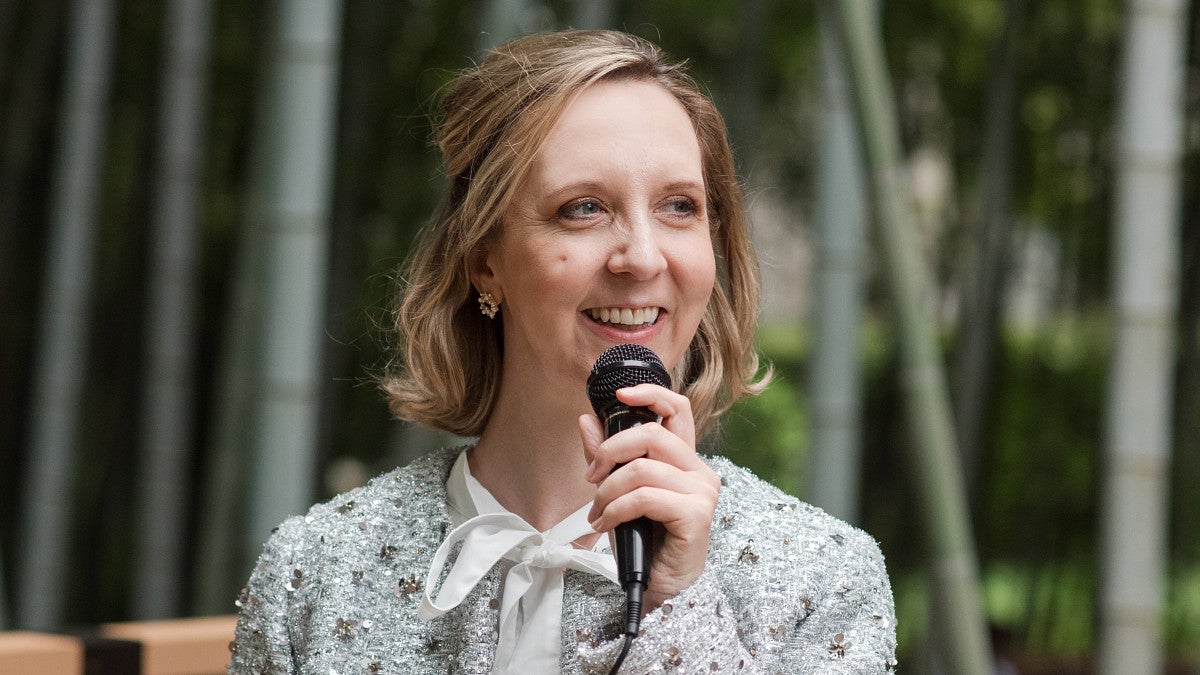
Originally from Oregon, Meg Tsukamoto B.A. ’00 (Japanese) has spent the last 25 years living and working in Japan. She is a professional emcee, serving as both interpreter and facilitator for large events such as wedding receptions, a niche she found after struggling to find a bilingual emcee for her own wedding in Japan.
While at the University of Oregon, she majored in Japanese in the College of Arts and Sciences (CAS) and minored in business. When she was in high school, she read an article about Oregon’s global trading partners, one of them being Japan. When she knew she wanted to pursue international business for her career, she decided to learn Japanese to enhance her chances of success.
Turns out it was an enhancement for her life.
“I use Japanese literally every single day, for work and personal. I can confidently say, my liberal arts degree has been very useful,” said Tsukamoto.
CAS Communications asked Tsukamoto about her time at the UO, how she developed an interest in Japanese, how she became proficient in the language — enough to work in the country successfully — and her advice for students.
CAS Communications: Do you have any favorite classes from your time in CAS?
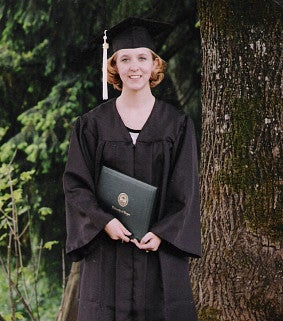
Meg Tsukamoto: While I graduated with a Japanese major, I actually began university as a Romance languages major, focusing on French and Spanish, and a minor in Japanese. So during my freshman year, I studied French, Spanish and Japanese, all at the same time. It was enthralling, but needless to say rather hectic!
Perhaps other Romance languages students can also attest, when English is your native tongue, there can be a tendency at first to try and apply English grammar, pronunciation patterns and vocabulary logic to a Romance language like French or Spanish. I struggled with my own assumptions that what I knew in English could be applied to Romance languages, only to quickly discover that the similarities I expected weren't there.
Japanese was the opposite experience for me. The writing system, the grammar, even the basic building blocks of the language were so different from English that there was no 'maybe it works like English.' I had to let go of assumptions entirely and accept what I was taught. It was truly learning a language from zero.
One definite advantage was that even from Japanese 101, the classes were taught by full-fledged professors rather than teaching assistants.
As the classes became more advanced, they were taught only in Japanese, no English support. I still vividly remember the professor instructing me solely in Japanese to get up from my desk and go to the light switch in the classroom and 'turn off' and 'turn on' the lights. I quickly learned those vocabulary words.
Following my sophomore year, I was given the opportunity to join a summer exchange program with Waseda University in Tokyo. It was an intensive summer program: one month at Waseda with local students, followed by another month at Lewis and Clark College in Portland with the same group of Japanese university students. My Japanese improved so much during that summer that, upon returning to the UO, I was able to place out of the 300-level courses and advance directly to the 400-level.
CASComms: What did you do after graduating from the UO?
MT: During that summer exchange program at Waseda University, I made so many amazing friends and knew I wanted to continue my Japanese studies there. So I applied and received a full-ride scholarship to return to Waseda for a one-year study abroad period that would have been my senior year at the UO.
After completing my studies, I donned the standard black suit as all the college grads do here and applied for corporate jobs in Japan. I figured if I had worked this hard learning Japanese, I might as well try and work for a few years… it’s been 25 or so now.
CASComms: Do you have any advice for students interested in pursuing a degree in Japanese, or another liberal arts degree?
MT: Graduating with a major in any foreign language is definitely a huge accomplishment. But in my experience, while four years of language acquisition may get your foot in the door, it’s still not quite native-level, business-level language.
It can take years of living and working in a foreign country to achieve a level of mastery. To be honest, I’m still learning Japanese on a daily basis.
Specifically for Japanese acquisition, I would recommend a thorough study of Keigo, or formal Japanese. You need to know how to properly use both honorifics and humble Japanese. This will set you apart from other Japanese learners and help you gain respect from locals. It is essential in a business setting, especially in the service industry.
To minimize my “foreigner” accent, I spent a great deal of time watching Japanese TV shows and mimicking what was spoken. The announcers on the news channels are considered to have the best Japanese accent, so I watched a great deal of news. The top broadcaster here, NHK, publishes a Japanese pronunciation dictionary. This is the gold standard if you want to strive for native-level pronunciation.
CASComms: What do you do now?
MT: Over the years, I’ve worked for both Japanese and international companies in a variety of roles. Early on in my career, I was actually aiming to become a TV reporter in Japan and even attended reporter school at NTV Gakuin, run by one of the major broadcasters here, Nippon TV.
I believe I was one of their first foreign students. I then went to a few reporter auditions, but nothing panned out at the time.
Everything changed when I got engaged and my fiancé and I began searching for a wedding venue in Japan. Here, many couples hold their receptions at hotels or wedding halls. The events are almost always facilitated by professional emcees.
It was a struggle to find a Japanese-English bilingual emcee for our celebration.
That experience made me realize that becoming a bilingual emcee would be the perfect way to combine what I had learned in TV reporter school with what I experienced planning my wedding in Japan. I wanted to support future international brides and grooms navigating the same process. So, I then enrolled in emcee school and studied how to work professionally in the Japanese wedding industry.
In general, wedding receptions in Japan are carefully planned down to the minute, sometimes even to the second. It is the emcee’s responsibility to help manage the flow of the reception, announcing each segment, introducing speakers, coordinating transitions with staff, keeping the program on schedule and ensuring the atmosphere stays warm and engaging.
In addition to cultural rules and expectations at Japanese wedding celebrations, there are many regulations for what the emcee can and cannot say. For example, words such as owaru (the verb for “to end”), hanareru (“to separate”), kaeru (“to return”) are considered taboo at weddings, and the emcee must not use them. Sometimes I have to be creative in how I reword something to keep within the parameters of acceptable word-usage.
In addition to weddings, I also emcee and interpret for corporate, cultural and major sporting events.
Beyond emceeing and interpreting, I also work as a narrator. I’ve recorded English voice-overs for shopping malls, airports, commercials and corporate promotional videos.
CASComms: Is there anything you experienced at the UO that you feel influenced your career?
MT: While at the UO, I worked at the Yamada Language Lab, helping language-learner students check out their VHS and cassette tapes (dating myself here). I enjoyed meeting other language learners and supporting them in their pursuits. I also had the opportunity to serve as the coordinator for FLIS (Foreign Language and International Studies) day. As an emcee, I draw on many of the same skills: coordinating moving parts, communicating with a wide range of people and keeping events running smoothly.
I’m grateful for all that I learned and experienced at the UO.
(Learn more about Tsukamoto’s life and work in Japan through her Instagram profile.)
— By Jenny Brooks, College of Arts and Sciences