
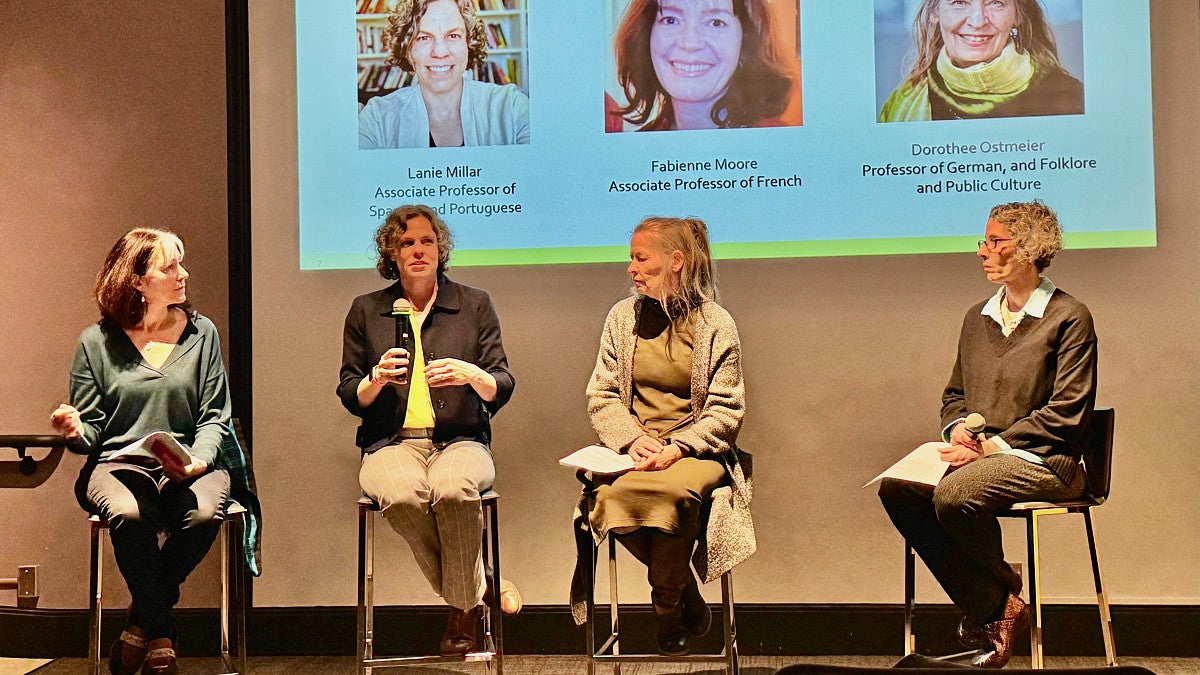
Faculty from the Schnitzer School of Global Studies and Languages took time at the winter Ring Lecture to unveil the proposed global environments major. The goal of the panel was to share the details of the proposed major and get feedback before it’s submitted for approval.
The proposed major is a result of the Schnitzer School’s work to expand its undergraduate degree programs that integrate the school’s strengths in the humanities and social sciences.
“It's a chance for students to continue to do environmental work, but to do it in a global context, and then to bring to bear both their environmental skill set and their cultural linguistic skill set,” said Rachel DiNitto , professor of Japanese literature.
The proposed major is built on the connections between the humanities, sciences and social sciences to encourage students to become effective environmental communicators. The proposed curriculum addresses environmental issues across diverse global cultures, geographies, languages and worldviews to illuminate the powerful connections between culture, language and the planet.
The global environments major is designed to fill a gap between global cultural and language studies and environmental inquiry.
Teaching local-global connections and impacts
To request input and gain support for the proposal, DiNitto moderated a faculty panel discussing the new major. Panelists who will teach in the new major, included Lanie Millar , associate professor of Spanish and Portuguese; Fabienne Moore , associate professor of French; and Dorothee Ostmeier , professor of German, and folklore and public culture.
Each panelist offered insight into how environmental questions shape — and are shaped by — their fields of study.
DiNitto runs the anti-nuclear speaker and film series and has been teaching environmental issues related to Japan for several years. “Through that work,” she said, “I felt like I was bringing something that wasn't present in the scope of environmental studies.”
Specifically, her teaching on radiation required detailing local-global connections between Japan and the US to help students understand the scale of the issues. She discovered that other faculty were working on issues that they didn't feel were as representative as they could be in environmental studies.
DiNitto quoted Geoff Mann and Joel Wainwright’s 2018 book “Climate Leviathan: A Political Theory of Our Planetary Future,” saying, “If good climate data and models were all that were needed to address climate change, we would have seen a political response in the 1980s.”
It’s clear we need something else, she said. “One of those things that we need is the ability to effectively translate these environmental messages and the environmental emergency.”
Using folklore as a guide for environmental problem solving
Ostmeier brought in the ecological impacts of Russia’s invasion of Ukraine where “the forests are burned, the waters are poisoned.” These disasters have ecological ramifications that reach far beyond Ukraine’s borders, further straining Germany’s ambitious environmental targets.
Ostmeier presents this issue as a tragic continuation of the anthropogenic forces that threaten environmental initiatives all over the world. She teaches about the Anthropocene, the time period that started when humanity became the dominant force shaping Earth’s ecosystems.
As a folklore scholar, Ostmeier said that the imaginary is where to find hope. With her students she examines our imaginary capacities as the source for always new ideas.
“The fantastic tales encourage imaginary thinking, and that's, from my perspective, the only way to get out of the logical structures which control our minds,” she said.
Studying environmental issues from a regional and linguistic perspective
Moore studies islands, which are on the front lines of environmental crises. Yet, she included hyperlocal examples of Eugene’s eco-feminist history as seen through the documentary “Outliers and Outlaws,” and the Klamath River dam removal, which had worldwide resonance and implications. “The zones connect, the struggles connect, for me.”
She is excited for the new proposed major because “I think it has meaning and it has purpose, which are two things I think our undergrads are really looking for. I think it says I care, and I want to contribute.”
Millar spoke on the large-scale effects of a post-colonial world, which she sees in her studies of the Caribbean, where hurricanes and tropical storms are increasing. Competing systems of knowledge between the global north and global south create tensions, and she believes the proposed major could consider all solutions on the same priority level.
Accompanied by specific linguistic and regional expertise, she said, “I think the global aspect within environmental studies is the biggest advantage that faculty in our school could offer.”
The Ring Lecture is an annual series of three events that provides a public forum for discussing topics of shared academic interest. Faculty suggest and vote on topics for the series.
Spearheaded by DiNitto, the global environments major was developed through the support of a Schnitzer School New Program and Course Development Award funded by the Undergraduate International Studies and Foreign Languages grant in summer 2025. The formal review process for a new major can take up to two years.